Today it was announced that samples taken from Syrian civilians had been tested in the UK for the presence of chemical weapons. Sarin was detected – what is it and how did they test for it?
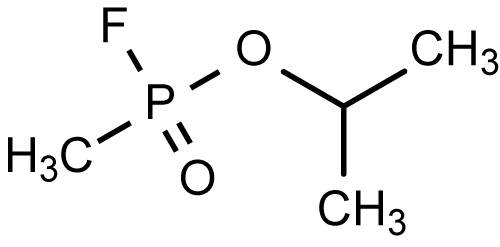
Sarin is a nerve gas, one of the ‘G-series’ (also known as GB) first produced in the 1930s. It became infamous after the Aum Shinrikyo cult released sarin in the Tokyo underground in 1995, killing 13 people and injuring 1000s more. A year earlier, also in Japan, sarin was released in Matsumoto killing 8. Sarin has the full name isopropyl methylphosphonofluoridate and can be seen in the figure below. It is a fast acting nerve agent, usually in liquid form and it’s effects can be seen in seconds and cause death within minutes. Sarin is controlled under the Chemical Weapons Convention and as such its use has not been widespread but it believed that Syria has large stockpiles.
In Syria there are mixed reports around who may have used the weapon – with US sources suggesting the ‘rebel’ side, whilst French and British sources suggest ruling government forces. Reports mention testing undertaken to confirm use of sarin. The tests, as reported on the radio news this morning, were undertaken on blood and urine samples, possibly smuggled out of Syria by French journalists. The samples sent to the UK were analysed at Defence Science and Technology Laboratory (Dstl), Porton Down – the Ministry of Defence establishment infamous for chemical weapons testing.
There are various analytical methods appropriate for the analysis – the most widely used would be gas chromatography- mass spectrometry or liquid chromatography-mass spectrometry. These will test the biological samples for the presence of the parent compound and also the main breakdown product GB Acid, or isopropyl methtylphosphonic acid (IMPA, as reported on the news). The IMPA molecule looks very similar to that of sarin but has a hydroxyl group (-OH) instead of the F. IMPA is a unique marker of sarin exposure. There is a further breakdown product also tested for, called methyl phosphonic acid (MPA), but this is common to many different nerve agents and also potentially fire retardant chemicals. As the sarin is broken down very rapidly in the body the chance of detecting it is slim, unless samples are taken within a few hours of exposure.
Other tests that give a longer chance of detecting exposure look for molecules formed when the proteins in the blood bond with the sarin rather than it being broken down. These macromolecules may be detectable for around 20 days.
The other samples that may be tested to tell us if sarin has been used in an area are environmental samples, such as water or earth. In the environment sarin is also altered fairly quickly to IMPA and then slowly to MPA. This would allow sampels of the surrounding area to be collected to determine if there was evidence of use, without having to collect human samples.
Also of interest to the forensic community was the apparent insistence by the US government that any samples tested and used as evidence included a full chain of custody. A chain of custody allows a court to be certain that the evidence has been handled correctly and securely from the time of collection through to the time of analysis. This would include ensuring the samples were sealed and were not able to be tampered with prior to analysis. As these samples were collected by journalists rather than scientists this evidence is not considered critical enough to cross the ‘red line’ of President Obama.
Thanks for reading. Please find us on Facebook or sign up above for updates!
Philosophal question for the day: when is a red line not a red line?
Very good question. I have been looking at various responses to this on twitter and other media and there seems to be a split in opinion. Many US based sites and blogs seem to suggest the French and UK are making this up to support their warmongering arguments. There seems to be large skepticism around this from the US so either they don’t want to believe the evidence or will wait until they can produce some of their own. Either they are trying to avoid another ‘sexed up’ dossier situation or are being deliberately obstructive. I’ll let others decide on that!